
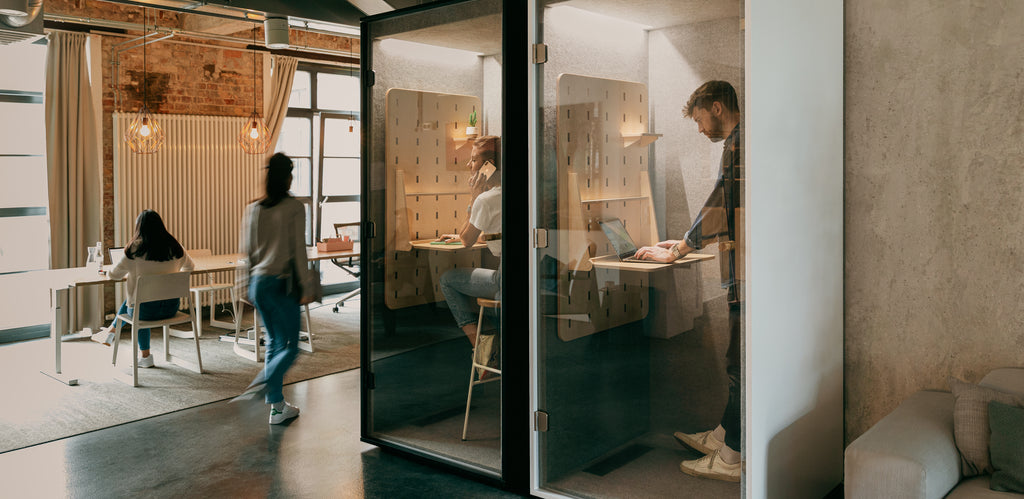
Many companies will give their employees the freedom to choose where they work in the future, introducing hybrid work. However, this brings several challenges for space planning: Who sits where and when? Are there always enough desks for everyone? And is there sufficient space for focused work or video conferences? A flexible office concept and efficient planning are therefore needed to design and successfully use the office of the future.
Hybrids working as a model for the future
Hybrid work seems inevitable, if one is to believe a Microsoft study. For the "2021 Work Trend Index", the company surveyed more than 31,000 employees and self-employed people in 31 countries and found that 73 percent want the permanent option to work flexibly, including remotely. At the same time, 67 percent also want more face-to-face contact and direct collaboration with their colleagues again after the pandemic. It is therefore not surprising that 66 percent of the managers surveyed say their company is considering a Conversion of office spaces to hybrid working in consideration.

This model offers significant advantages. Satisfaction and productivity employee productivity can increase, as the option to work remotely often improves work-life balance. Companies can use a flexible office concept in a smaller space Save on rental and energy costs. A hybrid workplace also brings the Employees in focus. It offers them flexible workspaces tailored precisely to their needs: open areas for communication, soundproof booths for focused work, and collaborative spaces where teams can meet and work together on their projects.
Hybrid Work: More Collaboration and Technology
It is clear that hybrid working can hardly be implemented using the old spatial concept. Anyone who sticks with it is faced with rows of empty desks, while at the same time there are not enough meeting rooms and colleagues are taking video calls in the hallway so as not to disturb anyone. Hybrid work often means a Remote-First Model, so that all employees are involved regardless of their current work location.
As a result the number of video conferences is increasing significantly on. During the pandemic, the video conferencing software Zoom recorded a 2,900 percent increase in meeting participants. The company increased its revenue in 2020 by 317 percent compared to the previous year. According to a study by Fortune Business Insights, the global video conferencing market will grow significantly in the coming years and reach revenue of US$12.99 billion by 2028.
To address this development towards hybrid communication, we need Meeting rooms with the appropriate technical equipment, so that calls can also be conducted in larger groups. 180-degree cameras with automatic zoom on the person speaking, suitable monitors and audio equipment, and perhaps even hybrid whiteboard tools ensure a better experience for video calls in hybrid teams. Soundproof phone booths such as HUUS One are ideal solutions for individuals, allowing them to make phone calls without disturbing colleagues or tying up valuable meeting rooms.
The office is changing from a general workplace into a Space for connection and collaboration. Teams meet in the office for brainstorming sessions and strategy development, but do the focused preparation at home. This will very likely lead to more meeting rooms and fewer workstations necessary.
When desk sharing is the norm, there are no longer any fixed desks, and employees also often work from home or on the go, that also means: fixed PCs are a thing of the past; laptops are needed instead. Hybrid working therefore also has Impact on the hardware requirements.
Corporate culture: A decisive factor and objective of space planning
Hybrid working can be a wide range of possibilities mean. For example, companies can employ a mix of remote workers and those who only work in the office. But they can also set fixed office days for all teams or give employees the freedom to choose how many days a week they want to work from home — and even let them decide spontaneously.
The decision about the hybrid work model a company wants to use is a very fundamental one. It is not just about the wishes of the employees, even though they should be involved in the process. A very important factor is the Corporate culture, which reflected in the hybrid workspace should.
If Flexibility being one of the most important values, this could mean complete freedom of choice for the teams. If, on the other hand, a company wants to create a culture based on Belonging and personal contact is based on, the office should be designed accordingly, and employees should have an incentive to meet there in person. The artist online marketplace Etsy offers great examples of spaces that reflect the company’s mission and values. The stylish and cosy offices feature plenty of relaxed communal areas decorated with craft supplies and displaying items made by Etsy sellers.

Companies should Goals for your office spaces define and create a concept. The shift toward hybrid working is a major opportunity to rethink the purpose of the office and choose a setup that works for everyone.
Determine occupancy and adjust room planning
Once the office philosophy is clear, practical steps follow that relate to the specific spatial planning. It begins with the question of how many days employees will spend in the office on average. If there is no guideline from the employer, a Useful survey, showing the wishes of the workforce. Based on this, the approximate occupancy and thus determine the need for workstations. With four office days per week, that is naturally higher than with two.
Broadly speaking, there are two options for how this can be implemented in everyday life: Set specifications or intelligent planning. With the first variant the company creates a planwho comes into the office and when. The teams must stick to these and can only swap with colleagues in exceptional cases. However, this option is rather rigid and does not fit the flexibility of the new world of work with self-determined employees.
Software solutions for tailored occupancy
With the second option, employees can decide relatively spontaneously when they want to come into the office. Workstations and meeting rooms are booked digitally. Very small teams can probably manage here without a specialized tool and, for example, use an online calendar or a spreadsheet. But from around ten employees onward, that becomes too confusing.
Larger teams can specialized software to use for booking workstations and meeting rooms. In the tool, employees can immediately see whether a desk is still available on the desired day and reserve it. If needed, teams can also gather in a specific area this way. If no workstation or conference room is available anymore, a different day simply has to be chosen.
Julius Urban is Co-Founder and CEO of Desk, a tool for coordinating the hybrid workplace. He explains: "The purpose of the office has changed; most employees now primarily use it as a place for collaboration and coming together, not to work there from 9 to 5. With software, the team can see who is in the office and who is working remotely. This makes it easier to decide whether the trip to the office is worth it on a given day or not."

Stay flexible with modular solutions
The occupancy survey can serve as a basis for determining the number of desks. But what about conference rooms like? Here too, companies can ask their employees and analyse the previous meeting frequency. Often, however, it is possible to difficult to predict, how many in-person meetings will actually take place after the transition to the hybrid workplace.
Best companies thus retain a certain degree of flexibility. For example, sliding doors can divide one large room into several. And for short brainstorming sessions with just a few people, a seating area or a standing table also works well. There may also be a courtyard or a roof terrace that can become a meeting point when needed and in good weather.
Meeting and phone booths offer very good opportunities to make optimal use of unused areas. They are easy to set up or move if they make more sense in a different location. This quickly creates a cost-effective alternative to a conference room created. How many phone booths a company needs naturally depends on the number of calls. We recommend for our single booth HUUS One a ratio of one box for ten employees.
Flexibility for future viability
With flexibility as a core value, continuous evaluation and optimisation become important success factors. This can mean, for example, conducting regular surveys with the teams (monthly, quarterly or annually) or using software to to evaluate the use of the office. This allows it to be adapted to the teams’ changing needs. The tool highlights particularly busy weekdays or phases of the month and can serve as a basis for tailoring office space planning even more closely to the needs of the company and its employees. Julius Urban explains: “Software can help companies understand their office space(s) and how they are being used. This makes it possible to quickly draw conclusions about whether, for example, it makes sense to to increase or reduce.”
HUUS founder Justina Clemens says: “After the pandemic, we have to Rethinking the office. The hybrid workplace will become a reality in many companies. It offers many opportunities to focus on employee satisfaction while using spaces more efficiently. Flexibility is the key: A flexible office is a future-ready office. We will need to keep trying things out and evaluating them to find the best solution for the current requirements. The space should be as modular and flexible as possible.”